Elegy
for the Greatest Generation

Elegy
for the Greatest Generation
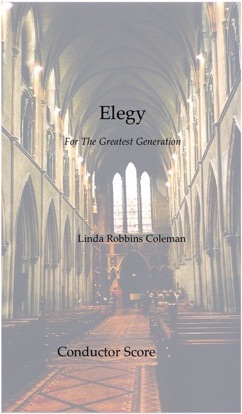
https://www.youtube.com/watch?v=l43SCqJEigI
A lovely piece, one that is perfect for the Memorial Day concert. Thanks...”
Neal Gittleman
Music Director and Conductor
Dayton Philharmonic Orchestra
Elegy For The Greatest Generation
was featured on the Memorial Day Concert
on May 30, 2010, and
again by the DPO on May 28, 2017.
“This is an amazing piece! Thank you so much for sharing.
You captured something so meaningful and this performance
couldn’t fail to move everyone in the attendance. Wow!”
Carey Bostian,
Music Director and Conductor
Iowa City Community String Orchestra
“I hadn’t picked up a program, but could read the tribute like a book.
What an exciting tribute - including tragedy, sorrow, elation, happiness -
an entire lifetime of emotion - wonderful!
This note was handed to my husband at the end
of the concert by a concert-goer who preferred to remain anonymous
Program Notes

Linda Robbins Coleman
February 1, 2010
Elegy
for the Greatest Generation
(a.k.a. Elegy)
This music is suitable for Masterworks concerts, Memorial Day, Veterans Day, and Fourth of July concerts, commemorative and special occasion concerts, and military or state funerals. While the title originally reads Elegy For The Greatest Generation for those who served and lived through the World War Two era, this title can also be shortened to Elegy to cover other eras (Korea, Vietnam, Gulf War, etc.) as well.
Instrumentation
Piccolo (this is doubled with 2nd Flute)
2 Flutes
2 Oboes
2 Clarinets in Bb
2 Bassoons
4 Horns in F
2 Trumpets in Bb **
3 Trombones
Tuba
Timpani
Percussion: (2 or 3 players needed in addition to timp.)
Snare Drum, Bass Drum, Crash Cymbals,
Suspended Cymbals, Gong (Tam Tam)
Triangle, Slap Sticks
Harp
Violin I
Violin II
Viola
Violoncello
Contra Bass
** There are two b-flat trumpet parts included with the parts since the piece is in B flat. If available, the first trumpet could use a cornet or Bflat bugle for the “taps” sections. The cornet would provide a bit more warmth, the bugle would sound more like “Taps” sounds at a gravesite. If this doesn’t work, the B flat trumpet throughout is fine. (If the trumpet players prefer “C” trumpet parts, I can easily provide these as well).
Duration: Approximately 12 minutes
Elegy For The Greatest Generation was given its World Premiere on Sunday, February 28, 2010 by the Des Moines Community Orchestra under the baton of Music Director and Conductor Carl B. Johnson.
Elegy For The Greatest Generation was performed
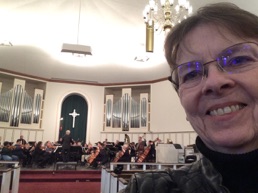
direction of Nan Washburn
on the concert “A Celebration of Courage”
honoring the 100th anniversary of Veteran’s Day
on November 8, 2019.
Photo: Linda at the dress rehearsal
of the Michigan Philharmonic
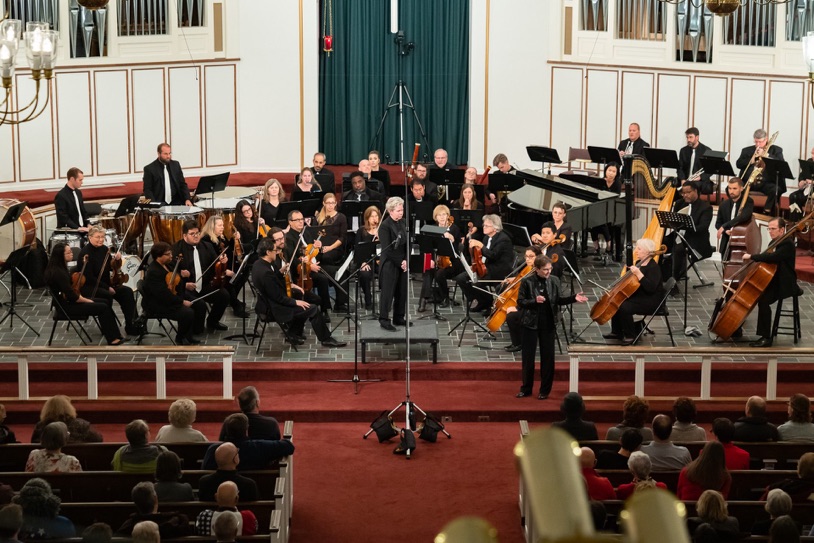
Photo: The Michigan Philharmonic “Celebration of Courage” Concert honoring the 100th Anniversary of Veteran’s Day. Nan Washburn, Music Director and Conductor. Linda Robbins Coleman, composer (with microphone).

I Will Meet You In The Music
I will meet you in the music
In a land that has no time.
The tempo will be beauty,
And the harmony sublime.
Our lyrics will be laughter,
And the form that we'll employ
Will be a lovely rhapsody
Whose encore will be joy.
In our land of music
There will never be a tear.
We will banish hate and anger
We will conquer any fear.
Our strength will come from friendship,
Our happiness from peace.
The song we’ll sing is love and hope
And we’ll hold each other dear.
I'll see you in the rhythm
And in the melodies we sing.
Our symphony of friendship
Throughout the land will ring
I will meet you in the music
Both in heaven and on earth.
The song we'll sing is love and hope,
And our language will be mirth.
And in our land of music
There will never be a tear.
We will banish hate and anger
We will conquer any fear.
Our strength will come from friendship,
Our happiness from peace.
The song we’ll sing is love and hope
And we’ll hold each other dear.
Linda Robbins Coleman
Copyright © October 26, 2005
Revised, © September, 2009
I was deeply honored to be commissioned to compose a new symphonic work honoring Richard Gerstenberger. From his days as a horn teacher and performer to his role of Music Director and Conductor of the Des Moines Community Orchestra, our paths crossed numerous times over the years. Richard was responsible for my first concert music commission when he asked me to write Fanfare and Celebration for the Des Moines Horn Club in honor of the Iowa Library Association’s centennial celebration. Additionally, his wife Martha hired me to tune pianos (my “day job” for sixteen years) at the Main Public Library. This commission was something I couldn’t refuse.
Throughout the creative process my goal was to create music appropriate to the occasion. Although my normal style is “cheerful and exuberant,” I knew that this concert would contain a certain melancholy but I did not want to write a dirge or something depressing. So I chose a form I dearly love – the tone poem – and wrote music that is reflective and meditative, yet optimistic and comforting. I might note that during the months I was composing, my mother was hospitalized and had numerous medical issues. Then my husband was treated for cancer and, following that, required surgery for a rare and dangerous tumor. Additionally, my adopted father almost died as a result of a medical mistake. It was not difficult to call up serious and melancholic emotions during these times. They all had a profound influence on my music.
As I searched for creative inspiration, I remembered a poem I had written in 2005 upon the death of another friend (who, coincidentally was a conductor). My intention was to set my poem to music as a “secular hymn” for chorus and orchestra. I decided that this would be an opportunity to explore that idea, albeit without the choir. I refined my poem, wrote the hymn, and then began to create my larger orchestra work. What evolved became an elegy - defined by the dictionary as “a poem of serious reflection, typically a lament for the dead.” Composing through many long nights, I referred to Richard’s obituary for ideas. I felt a connection to his service during World War II since my husband had also served in the European Theatre. I decided to weave that inspiration into my musical poem.