Voices of Wounded Knee
Voices of Wounded Knee
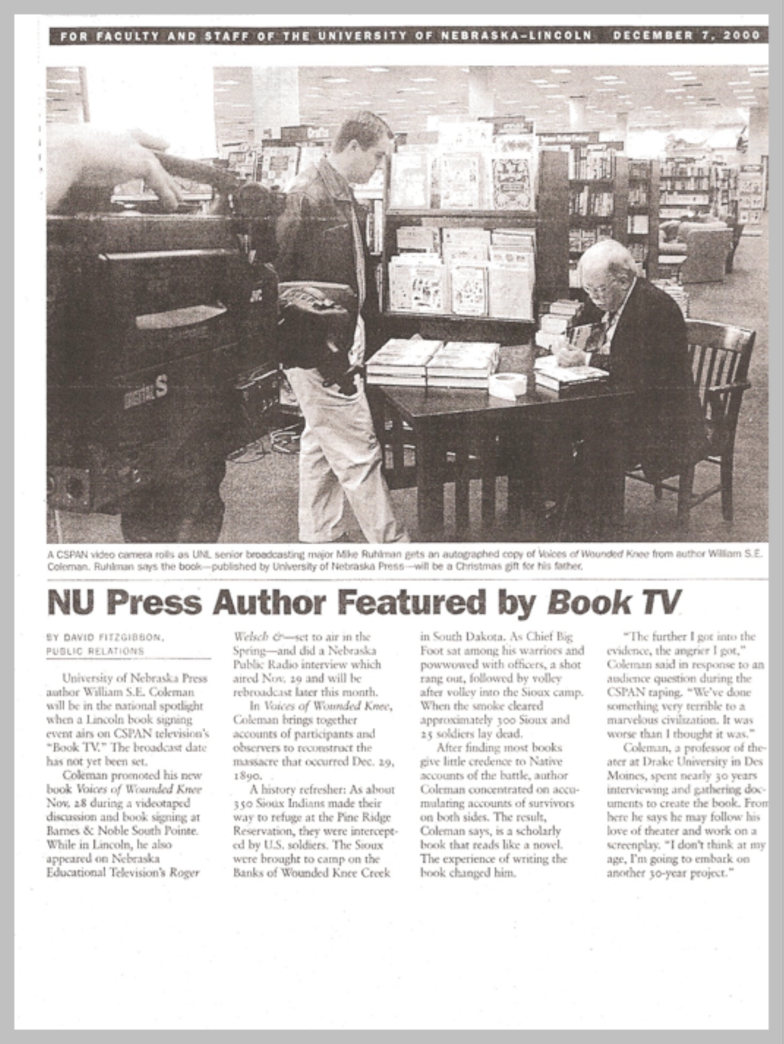
William S. E. Coleman is a professor emeritus of theatre at Drake University in Des Moines, Iowa.
He and his wife, - the internationally acclaimed composer Linda Robbins Coleman - spent nearly thirty years gathering documents from collections in the United States and abroad to create this book.
This book’s high value is in its completeness. Coleman has assembled a multitude of sources, with explanatory comments. The book is a requisite for students of the tragedy and the Indian Wars period.
Dee Brown, author of Bury My Heart At Wounded Knee
The material is exactly what is called for - a chance for the Indians to speak about their past and the events that surrounded Wounded Knee. This is an important book.
Troy Johnson, coeditor of Red Power: The American Indians’ Fight for Freedom
Devoted research results in a remarkable book.
Kevin Brownlow, film historian
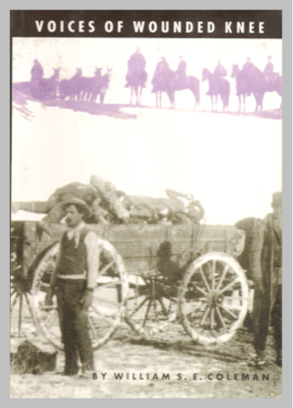
Jacket photo courtesy of the
Nebraska State Historical Society
Voices of Wounded Knee is available through the University of Nebraska Press, http://www.nebraskapress.unl.edu/
http://www.barnesandnoble.com/
ISBN-13: 9780803264229
On December 29, 1890, two weeks after the killing of Sitting Bull, the United States Seventh Cavalry opened fire on Miniconjou Ghost dancers near Wounded Knee Creek. Some army officials claimed that the dancers were armed and that the Ghost Dance was a call for the extermination of all whites. Many Lakotas believed that the massacre stemmed from the Seventh Cavalry 7’s enduring bitterness over Custer’s loss at the Little Big Horn fourteen years earlier.
In Voices of Wounded Knee, William S.E. Coleman brings together for the first time all of the available sources - Lakota, military, and civilian. He recreates the Ghost Dance in detail and shows how it related to the events leading up to the massacre. Using accounts of participants and observers, Coleman reconstructs the massacre moment by moment. He places contradictory accounts in direct juxtaposition, allowing the reader to decide who was telling the truth. His balanced treatment suggests that the massacre grew out of decades of broken treaties, cultural misunderstandings, power struggles between the Department of the Interior and the U.S. Army, and erroneous and inflammatory reports by irresponsible members of the press.
This is the first account in which participants have been allowed to tell the story almost entirely in their own words. . . . [Coleman] has welded these accounts . . . into a riveting narrative that tells how the massacre emerged out of a long string of broken treaties, cultural mistrusts, governmental rivalries, and inflammatory press reports."—Library Journal
"This is one of the most informative books written about the unfortunate circumstances leading to the 1890 debacle at Wounded Knee. Twenty-five years in the making, it provides insights into the Ghost Dance phenomenon with its visions and beliefs in the Messiah's arrival."—Choice
"Voices of Wounded Knee reveals a basic truth about the power of collective self-delusion that is part of history. Scholars, not just Indian studies specialists, will find this book tantalizing and stimulating, and students can benefit from the ‘collective biography’ to test their abilities in synthesis and judgement. This work should be on the shelves of every library."—Gregory Gagnon, North Dakota History